Laboratory of Tandetron (LT)
Laboratory of Tandetron is a part of Center of Accelerators and Nuclear Analytical Methods (CANAM).
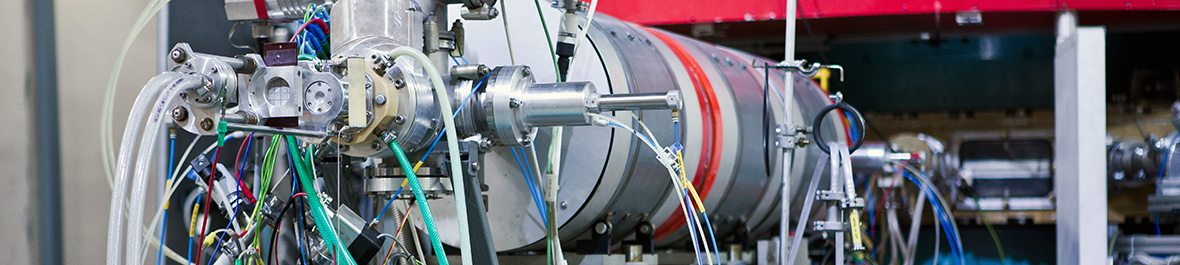
The accelerator Tandetron 4130 MC, put into operation in 2005, is used for production of ion beams with energies in the range from 400 keV to 30 MeV of almost all elements of the periodic system for the trace element analysis by means of the nuclear analytical methods. It is the medium-current (MC) version with a terminal voltage varying from 200 kV to 3 MV.
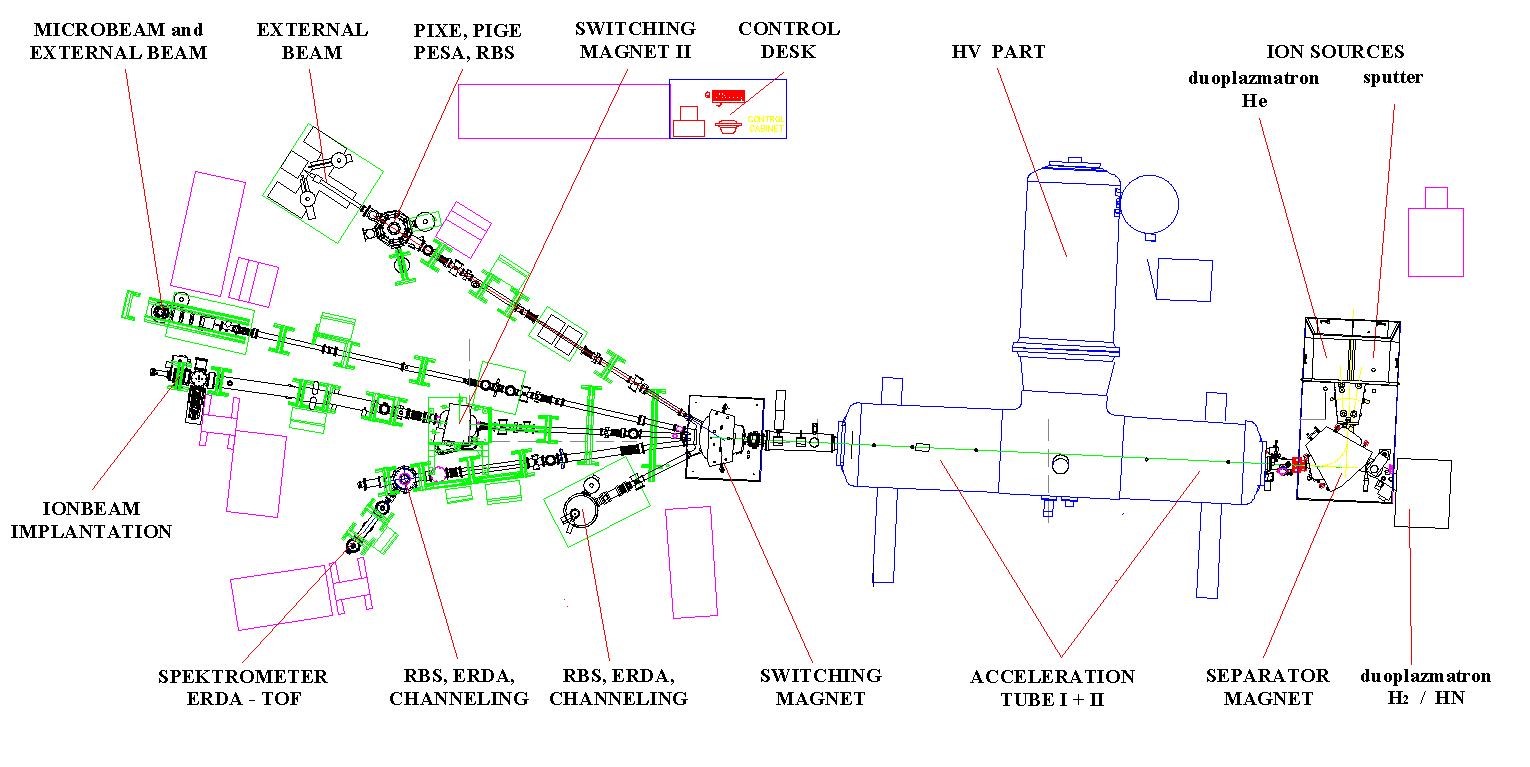 Scheme of the Laboratory of Tandetron
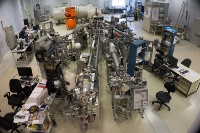
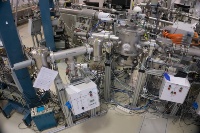
The main laboratory accessories are devices for material characterization by standard nuclear analytical techniques (RBS, RBS-channeling, ERDA, ERDA-TOF, PIXE, PIGE, and Ion-Microprobe with less than 1 μm lateral resolution) and for high-energy implantation. Broad portfolio of Ion Beam Analytical methods is used in material research in optics, nanooptics and electronics, bionics, dosimetry, doping of semiconductors, space and nuclear power technologies, wear resistant materials etc. Heavy and light ion microprobe is effectively used for ion beam lithography and 3D elemental mapping using ion microprobe in combination with STIM, PIXE, PIGE and RBS), respectively. Versatile ion implantation instrumentation is used for modification, intentional defect engineering, nanostructuring of materials as well as for ionizing radiation testing in dosimetry and detector development, where also external beam is for disposal. Analytical methods are successfully and effectively used in many applications: ion beam interaction with solids, nanostructuring, nano and micro-structure synthesis and characterization, quantitative and qualitative elemental analysis and high resolution elemental depth profiling, trace element characterization etc.
Material research belongs to traditionally progressive fields of technology. However, due to the continuous miniaturization, the underlying structures are far beyond the analytical limits of the most of conventional methods. Nuclear analytical methods provide this possibility as they use probes of similar or much smaller dimensions (particles, radiation).
LT is equipped with small deposition and complementary analytics laboratory including layer deposition techniques (CVD, two-magnetron sputtering system for various metal and bi-metal coating deposition, laser source for irradiation, ablation and microstructuring) and analytical methods (optical ellipsometry, optical analysis in UV Vis-NIR range of wavelengths).
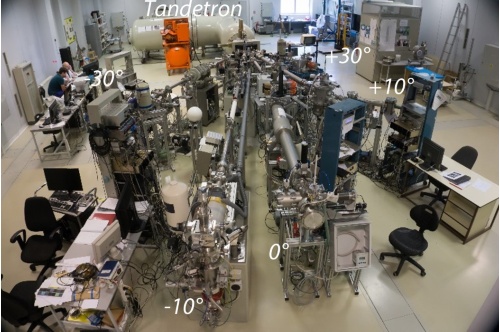
The angles in the Laboratory of Tandetron
Staff qualification and the parameters of the experimental devices of the laboratory are fully comparable to similar ones worldwide. With this equipment the laboratory is unique in the Czech Republic and it is able to meet all specific demands of Czech and foreign research organizations.
Video
Final Call for Beam Time Proposals – ReMade Project
The clock is ticking, and the window is closing—this is your last chance to secure experimental access within the ReMade project in Tandetron Laboratory of Nuclear Physics Institute of CAS. For those eager to push the boundaries of materials science, ion beam analysis, and cutting-edge experimentation, the Tandetron Laboratory stands ready to welcome your boldest ideas.
With its state-of-the-art ion beam capabilities, the Tandetron Lab offers a rare opportunity to conduct inovative experiments that can shape the future of sustainable materials and circular technologies. Whether you're exploring surface composition, depth profiling, or elemental mapping, this is the moment to bring your research to life.
To ensure all access and reporting are completed within the project timeline, here’s what you need to know:
- 🗓️ 24 April 2026 – Final submission for preproposals
- 🗓️ 8 May 2026 – ARIA portal closes to NPI proposals
- 🗓️ 15 June 2026 – Final date to schedule all access
- 🗓️ 30 July 2026 – All experimental access must be completed
- 🗓️ 31 August 2026 – Final reporting and reimbursement requests submitted
The Rolling Call opens 1 September 2025, but don’t wait—submissions for LT-specific proposals will close 8 May 2026 to allow for feasibility and scientific review.
Tandetron Laboratory is your gateway to precision, innovation, and impact.