
Research and Development
The Nuclear Physics Institute of the Czech Academy of Sciences (NPI) is one of the 54 public research institutions of the Czech Academy of Sciences (CAS). With approximately 250 employees, including around 90 research scientists holding a Ph.D. degree and 35 doctoral students, it is the largest Czech institution in the field of nuclear physics. NPI has long-standing expertise in this area and achieves internationally recognized results in research related to the environment, health, and energy security, as well as in environmental science, medicine, radiopharmacy, and materials research.
These achievements are to a significant extent founded on NPI’s instrumental and technological expertise in accelerator technology and nuclear analytical methods. The Institute’s activities are strongly oriented towards participation in large international collaborations. Cooperation within ALICE@CERN, STAR@BNL, and HADES/CBM@GSI/FAIR focuses on the study of hot and dense nuclear matter produced in heavy-ion collisions. The KATRIN project aims to improve the sensitivity of neutrino mass determination. ESS is a pan-European spallation neutron source currently under construction. At GANIL/SPIRAL2, NPI research groups participate in studies of nuclei far from the line of stability and are involved in the development of facilities for neutron-oriented research.
The Czech participation in these international collaborations is supported by NPI’s role as the host institution of the large research infrastructures ESS-Scandinavia-CZ, FAIR-CZ, and SPIRAL2-CZ, and as a partner in the BNL-CZ and CERN-CZ research infrastructures.
These infrastructures are included in the Roadmap of Large Research Infrastructures for Research, Experimental Development and Innovation of the Czech Republic 2016–2026 (RLIR).
Research infrastructure CANAM - Centre of Accelerators and Nuclear Analytical Methods connects large experimental facilities of the NPI in a synergistic network. It includes ion, electron and neutron beams and its work is mainly carried out by three departments of the NPI: the Department of Neutron and Ion Methods (DNIM), the Department of Accelerators (DA) and the Department of Radiation Dosimetry (DRD).
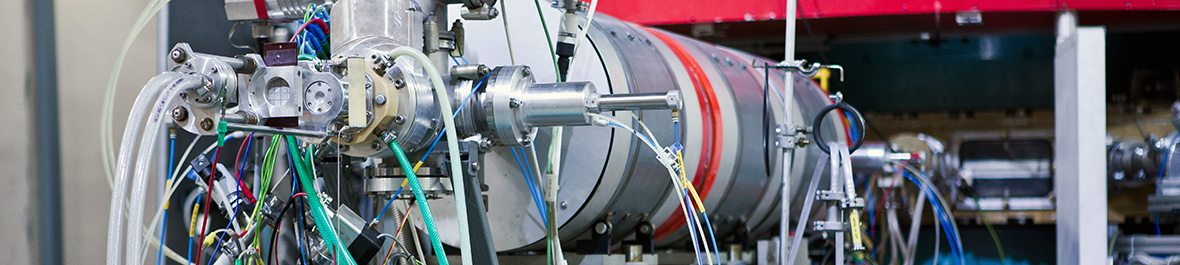
CANAM is a center for research into tasks in a wide range of scientific fields using accelerated ion beams on cyclotron accelerators U-120M and TR-24, the linear electrostatic accelerator Tandetron 4130 MC and the accelerator mass spectrometer MILEA. Neutron beams are also available, namely from devices installed on the neutron channels of the LVR-15 research reactor and fast neutrons from production targets on cyclotrons. The Microtron MT25 cyclic accelerator provides primary electron beams and photons and neutrons can be produced secondarily.
Analytical, characterization, modification and production methods based on charged particles and neutrons provide opportunities for research into interactions and substances that cannot be obtained in other ways and which are indispensable for basic and applied studies in various fields of research.
Large research infrastructures and centers
- The Facility for Antiproton and Ion Research - FAIR-CZ
- The European Spallation Source - ESS Scandinavia - CZ
- Systeme de Production d’Ions Radioactifs Accélérés en Ligne - SPIRAL2-CZ
Partnership
Brookhaven National Laboratory - BNL
European Organization for Nuclear Research - CERN
Czech National Node of European Infrastructure for Translational Medicine - EATRIS-CZ
European Research Infrastructure for Heritage Science - E-RIHS
Research projects
The Nuclear Physics Institute of the CAS serves as the host institution for a wide range of national and international projects. An overview of the research projects currently underway, as well as a list of projects completed in the recent past, can be found on the dedicated pages.
Experimental equipment
NPI of the CAS is the largest operator of accelerators in the Czech Republic. Two of the main ones are the new cyclotron TR-24 of the Canadian company ACSI and the older cyclotron U-120M, for lower energy there is used the linear accelerator Tandetron. For experiments with electron beams, the smaller Microtron cyclic accelerator is used. Other important experimental devices are fast neutron sources, using U-120M accelerator beams, and neutron diffraction and scattering devices in the LVR-15 reactor. Radiocarbon dating and paleoenvironmental research are carried out using the MILEA accelerator mass spectrometer (AMS) developed by the Swiss company IONPLUS AG.
