
Jan Vaněk played a key role in a study published in NATURE
15. 04. 2026

Jan Vaněk, a former PhD student at the Nuclear Physics Institute, whose academic advisor was Assoc Prof Jaroslav Bielčík and whose research advisor was Assoc Prof Jana Bielčíková, was one of two members of the STAR Collaboration responsible for the key analysis that led to the results published this past February in the prestigious journal NATURE. These results provide experimental evidence that matter can arise from the quantum vacuum. Jan Vaněk conducted this study during his postdoctoral fellowship at the Brookhaven National Laboratory (BNL) in the U.S., where he analyzed data from high-energy proton collisions at RHIC (Relativistic Heavy Ion Collider). Since the fall, he has been working as a postdoctoral researcher at the University of New Hampshire.
“Being published in NATURE is, above all, a great joy for me. Scientific work is a long-term process, and the opportunity to watch Jan gradually grow—from his bachelor’s studies through his doctoral studies here at the Nuclear Physics Institute to fully independent scientific work at BNL—is very fulfilling. It is also gratifying to see that he has not only further developed the experience and foundations he gained during his scientific work here, but has also taken them in a completely new direction,” says J. Bielčíková regarding his success, adding: “I sincerely hope that once he completes this stage of his scientific career in New Hampshire, his path will bring him back to our institute.”
J. Vaněk himself fondly recalls his collaboration with J. Bielčíková. “J. Bielčíková provides her students with excellent support, both in terms of their academic development and indirectly, for example by offering them opportunities to attend international conferences or undertake internships at the world’s top research institutions, such as BNL or Berkeley National Laboratory,” he says. At the same time, he praises the doctoral program at the NPI specifically the Ultra-Relativistic Heavy Ion Group in the DHIP. “Thanks to the informal environment here, students—including myself—feel like a real part of a scientific team that is pushing the boundaries of knowledge further and further,” concludes J. Vaněk.
A study published in the journal NATURE describes how high-energy proton collisions impart energy to virtual quark pairs and transform them into real, measurable particles. The vacuum is not empty, but consists of fluctuating energy fields in which these pairs are constantly being created and annihilated. Scientists from the STAR experiment studied Lambda particles containing a strange quark and their antiparticles with a strange antiquark. They found that these particles retain a correlated spin corresponding to their origin—as if they were created as “quantum twins.” This provides strong evidence that they arise from a single virtual quark-antiquark pair and thus carry the “memory” of the quantum vacuum. This discovery opens up new possibilities for studying the origin of matter and the transition between the quantum and classical worlds.
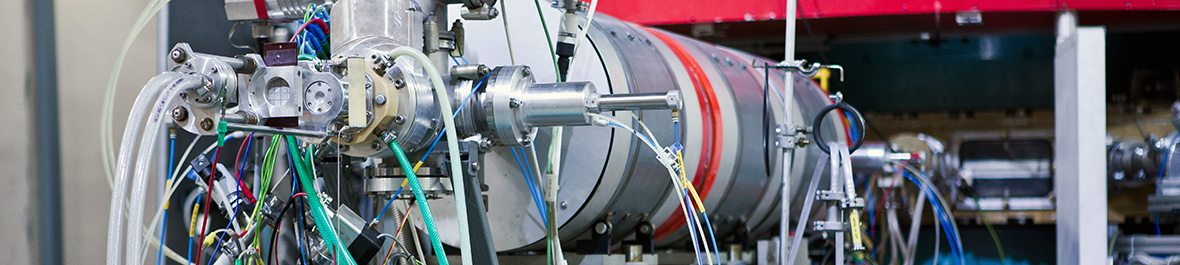
Photo: BNL - Kevin P. Coughlin
Read also
- SPACEDOS detectors meet the limits for operation aboard a spacecraft
- Ivo Světlík awarded the First-class Medal of the Ministry of Education, Youth and Sports
- NPI CAS and Korea’s KINS Strengthen Cooperation in Cosmic Radiation and Aviation Radiation Protection
- NPI CAS organised the 29th international WRMISS workshop
- NPI CAS was the main organizer of the 26th European Conference on Few-Body Problems in Physics
- The Mayor of Brno visited the Laboratory of Microtron
- Describing unusual winter lightning could help extend the lifespan of wind turbines
- The solar eclipse and its impact on cosmic radiation
- 3D scanning helps select eggs for a future ISS mission
- Unique CRL method opens new possibilities for dating prehistoric rock art
