
We are participating in two new projects focused on cosmic rays
30. 05. 2025
In early 2025, the Nuclear Physics Institute of the Czech Academy of Sciences (NPI CAS) joined two major research efforts focusing on improved detection and evaluation of cosmic radiation – a key aspect of aviation and space safety. Both projects are being carried out by the team from the Department of Radiation Dosimetry.
The first project, ADVADOSE, funded by the TAČR TREND programme and led by ADVACAM, aims to develop a new high-resolution radiation detector called AdvaDose. This device will be part of the AIRWATCH monitoring platform.
NPI CAS is a research partner responsible for:
- developing testing methodologies for airborne operation,
- validating outputs through simulation,
- linking the device with existing dosimetric systems.
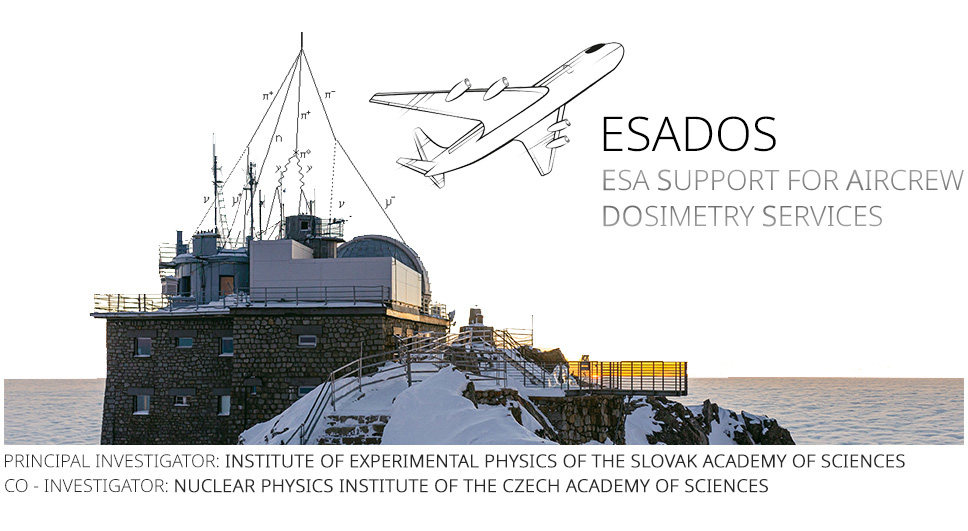
The second project, ESADOS (ESA Support for Aircrew DOsimetry Services), is coordinated by the Institute of Experimental Physics of the Slovak Academy of Sciences and funded by the European Space Agency (ESA). Its goal is to develop an independent European source of heliocentric potential – a key parameter for calculating aircrew exposure.
NPI CAS contributes by:
- validating the model using in-flight radiation measurements,
- improving the reliability and accuracy of dosimetric computations.
These projects strengthen our expertise in applied dosimetry and contribute to safer aviation and future space missions.
Read also
- NPI hosted a workshop on the potential impact of Earth's geomagnetic field on climate
- NPI scientists test dosimeters for Czech astronaut at LR-0 reactor
- NPI opens new facility with a high-activity cobalt irradiator
- SPACEDOS detectors meet the limits for operation aboard a spacecraft
- Ivo Světlík awarded the First-class Medal of the Ministry of Education, Youth and Sports
- NPI CAS and Korea’s KINS Strengthen Cooperation in Cosmic Radiation and Aviation Radiation Protection
- NPI CAS organised the 29th international WRMISS workshop
- NPI CAS was the main organizer of the 26th European Conference on Few-Body Problems in Physics
- The Mayor of Brno visited the Laboratory of Microtron
- Describing unusual winter lightning could help extend the lifespan of wind turbines
