
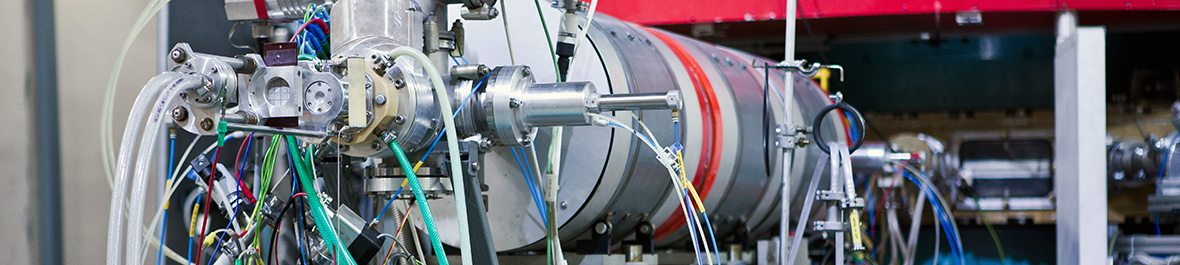
SPACEDOS detectors meet the limits for operation aboard a spacecraft
24. 09. 2026

The development of the CZPAD experiment, which the Nuclear Physics Institute of the Czech Academy of Sciences is preparing for the scientific programme of Czech astronaut Aleš Svoboda’s mission to the International Space Station, has entered another phase. During recent measurements, the SPACEDOS detectors met the required electromagnetic emission limits for equipment intended for operation aboard the Crew Dragon spacecraft and in the European Columbus module on the ISS. The testing was carried out ahead of the production of the flight units that will be used for the mission.
Engineering models of the SPACEDOS detector were tested in the anechoic chamber of the Electrotechnical Testing Institute (EZÚ). The aim was to verify the electromagnetic compatibility (EMC) of the device, specifically whether its electronics comply with the specified electromagnetic emission limits and will not interfere with other equipment.
Electromagnetic compatibility is an important requirement for equipment intended for operation in space. Using calibrated instruments at EZÚ, emission levels were therefore measured across different frequency bands and subsequently compared with the limits specified for operation aboard Crew Dragon and in the Columbus module. The results confirmed that the tested SPACEDOS engineering models comply with these requirements.
Personal Dosimetry for Astronauts
CZPAD (Czech Personal Active Dosimeter) is an NPI CAS experiment focused on developing a personal dosimetry system to measure an astronaut’s radiation exposure during spaceflight. Based on SPACEDOS detectors, the system will enable real-time monitoring of radiation exposure at different locations on the astronaut’s body, including the neutron component of cosmic radiation. The results of the experiment may contribute to the further development of personal dosimetry and radiation protection for astronauts on future space missions.


Read also
- NPI hosted a workshop on the potential impact of Earth's geomagnetic field on climate
- NPI scientists test dosimeters for Czech astronaut at LR-0 reactor
- NPI opens new facility with a high-activity cobalt irradiator
- Ivo Světlík awarded the First-class Medal of the Ministry of Education, Youth and Sports
- NPI CAS and Korea’s KINS Strengthen Cooperation in Cosmic Radiation and Aviation Radiation Protection
- NPI CAS organised the 29th international WRMISS workshop
- NPI CAS was the main organizer of the 26th European Conference on Few-Body Problems in Physics
- The Mayor of Brno visited the Laboratory of Microtron
- Describing unusual winter lightning could help extend the lifespan of wind turbines
- The solar eclipse and its impact on cosmic radiation
