
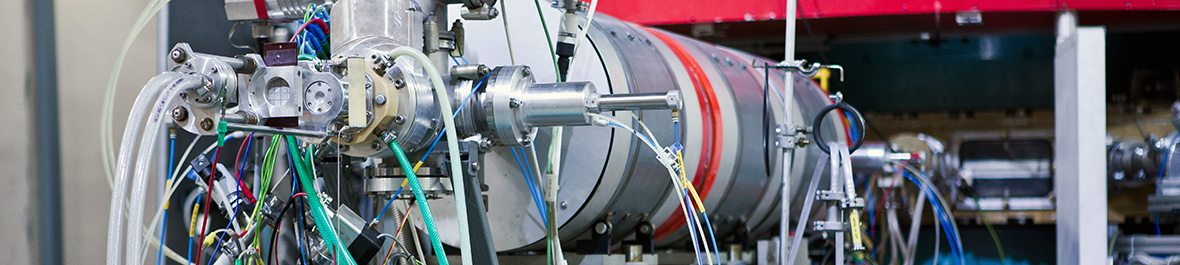
NPI scientists test dosimeters for Czech astronaut at LR-0 reactor
09. 10. 2026

The development of the CZPAD experiment, which the Nuclear Physics Institute of the Czech Academy of Sciences is preparing for the scientific programme of Czech astronaut Aleš Svoboda’s mission to the International Space Station (ISS), has entered another phase of testing. At the LR-0 research reactor operated by the Research Centre Řež, scientists tested SPACEDOS detectors that will form part of a personal dosimetry system designed to measure the astronaut’s radiation exposure during the mission.
The measurements, carried out on 21 and 23 September 2026, aimed to verify the design of SPACEDOS detectors optimised for the detection of thermal neutrons. Neutrons are one of the components of the space radiation environment that CZPAD is designed to monitor during the mission.
How does SPACEDOS detect neutrons?
A neutron does not produce a signal in a silicon detector in the same way as electrically charged particles. To detect neutrons, scientists therefore use special conversion layers made of lithium fluoride enriched with the lithium-6 isotope (6LiF). The layers used for the tests were prepared by colleagues from the Institute of Macromolecular Chemistry of the Czech Academy of Sciences.
Lithium-6 has a high probability of interacting with a neutron. This reaction produces two electrically charged particles – a helium-4 nucleus and a triton (a hydrogen-3 nucleus). These particles can then produce a measurable signal in the silicon diode of the SPACEDOS detector. The 6LiF conversion layer thus enables the detector to register neutrons, which are themselves electrically neutral.
For the tests, the scientists used the LR-0 research reactor, which provides a well-defined reference neutron field. This allows them to study the response of detectors with different conversion layers under known conditions, compare the results and select the optimal configuration of the neutron module.
Testing at the LR-0 reactor is part of the broader preparation of the SPACEDOS system for the space mission. The detectors are undergoing various types of verification focused both on their ability to measure individual components of the radiation field and on the requirements associated with operation in space. Recently, for example, their engineering models underwent electromagnetic emission measurements in the anechoic chamber of the Electrotechnical Testing Institute (EZÚ), where they met the specified limits for operation aboard the Crew Dragon spacecraft and in the European Columbus module on the ISS.
The neutron detector tests were carried out in cooperation with the Research Centre Řež, which provided access to the LR-0 research reactor infrastructure, and the Institute of Macromolecular Chemistry of the Czech Academy of Sciences, where the 6LiF conversion layers were prepared.
Find out more about CZPAD here.


Read also
- NPI opens new facility with a high-activity cobalt irradiator
- SPACEDOS detectors meet the limits for operation aboard a spacecraft
- Ivo Světlík awarded the First-class Medal of the Ministry of Education, Youth and Sports
- NPI CAS and Korea’s KINS Strengthen Cooperation in Cosmic Radiation and Aviation Radiation Protection
- NPI CAS organised the 29th international WRMISS workshop
- NPI CAS was the main organizer of the 26th European Conference on Few-Body Problems in Physics
- The Mayor of Brno visited the Laboratory of Microtron
- Describing unusual winter lightning could help extend the lifespan of wind turbines
- The solar eclipse and its impact on cosmic radiation
- 3D scanning helps select eggs for a future ISS mission
