
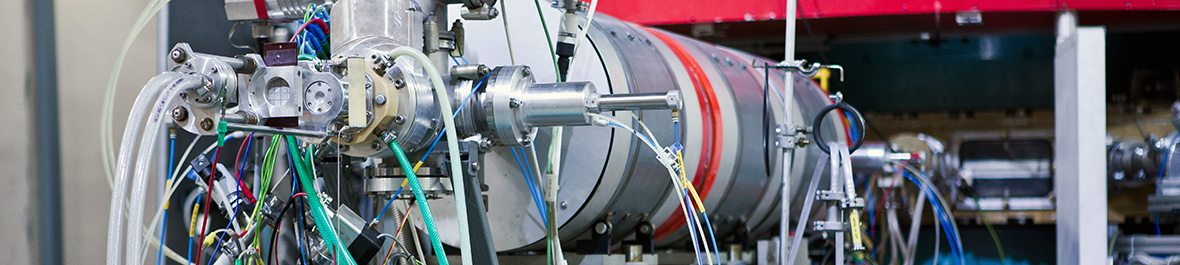
NPI opens new facility with a high-activity cobalt irradiator
30. 09. 2026

The Nuclear Physics Institute of the Czech Academy of Sciences (NPI CAS) is opening a new irradiation facility equipped with a high-performance T100 cobalt irradiator. The new facility will expand NPI CAS’s research capabilities, including in space research and the preparation of the CZPAD and ZOE experiments for the Czech Journey to Space programme. With an activity of 300 TBq (terabecquerels), the T100 will rank among the most powerful facilities of its kind in the Czech Republic. Radomír Pánek, President of the Academy of Sciences, also attended the grand opening on September 30.
The T100 irradiator can generate an intense and precisely defined field of ionising radiation and irradiate samples under controlled conditions. This allows scientists to work with defined doses and dose rates and subsequently evaluate the effects of radiation on biological samples, materials, or electronic components.
The T100 will also be used for the calibration and verification of dosimeters, including detectors used in radiotherapy, as well as for the development and testing of new dosimetry systems.
Other potential applications include radiobiological research, radiation-resistance testing of materials and electronics, research into scintillation materials, retrospective dosimetry, and sample irradiation for further experiments.
“The new irradiator will significantly expand our research capabilities and connect several areas that NPI has been pursuing for many years – from precise measurements of ionising radiation and radiobiology to the development of technologies for space research. The facility will enable us to further advance these research areas while opening up new opportunities for cooperation with other research institutions and the application sector,” says Ondřej Svoboda, Director of the Nuclear Physics Institute of the Czech Academy of Sciences. According to Svoboda, the irradiator will complement NPI’s other research facilities, which include five particle accelerators and a neutron source provided by a research nuclear reactor.
The new facility replaces the original irradiator, which had been in operation at the site for several decades and had reached the end of its technical service life. The acquisition of the T100 irradiator and the reconstruction of the associated premises represented an investment of CZK 21 million by the Czech Academy of Sciences.
The irradiator will also be used in the preparation of the CZPAD and ZOE space experiments, which NPI is developing for the scientific programme of Czech astronaut Aleš Svoboda’s mission to the International Space Station. CZPAD focuses on personal dosimetry for the astronaut, while ZOE investigates the effects of the space environment on the early embryonic development of vertebrates using Japanese quail embryos. The controlled and therefore measurable radiation produced by the T100 irradiator will make it possible, among other applications, to simulate the radiation component of the space environment.
About the T100 Irradiator
The T100 high-dose-rate gamma irradiator is a laboratory device designed for applications using high-energy gamma radiation from the cobalt-60 (⁶⁰Co) radionuclide (1.17 and 1.33 MeV), with a high activity of up to 444 TBq. The device is primarily designed for use in calibration laboratories.
The T100 irradiator is based on the design of medical radiotherapy equipment but has been adapted for use in metrology laboratories.
The device can generate an intense and precisely defined field of ionising radiation and irradiate samples under controlled conditions. This allows scientists to work with defined doses and dose rates and subsequently evaluate the effects of radiation on biological samples, materials, or electronic components.
Source: ÚJP PRAHA a.s.
Photos: Czech Academy of Sciences / Josef Landergott and ÚJP Praha a.s. / Daniel Kasal


Read also
- Jan Borovička received the President of the Czech Academy of Sciences Award for Science Communication
- NPI hosted a workshop on the potential impact of Earth's geomagnetic field on climate
- NPI scientists test dosimeters for Czech astronaut at LR-0 reactor
- SPACEDOS detectors meet the limits for operation aboard a spacecraft
- Ivo Světlík awarded the First-class Medal of the Ministry of Education, Youth and Sports
- NPI CAS and Korea’s KINS Strengthen Cooperation in Cosmic Radiation and Aviation Radiation Protection
- NPI CAS organised the 29th international WRMISS workshop
- NPI CAS was the main organizer of the 26th European Conference on Few-Body Problems in Physics
- The Mayor of Brno visited the Laboratory of Microtron
- Describing unusual winter lightning could help extend the lifespan of wind turbines
