
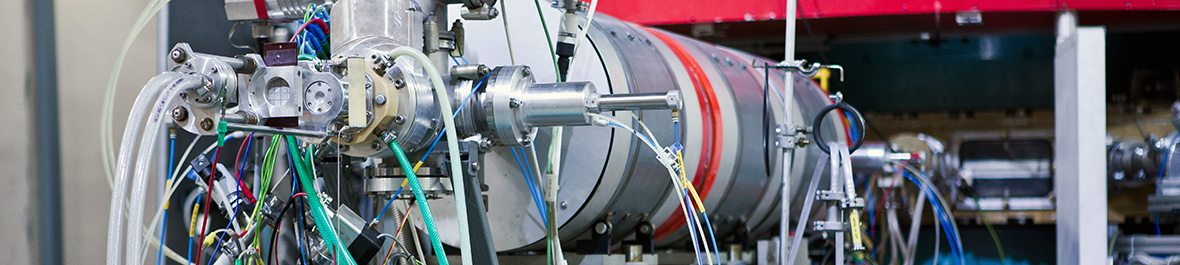
Testing of a new large-area diode at the HIMAC accelerator
01. 04. 2026
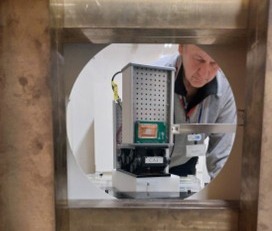
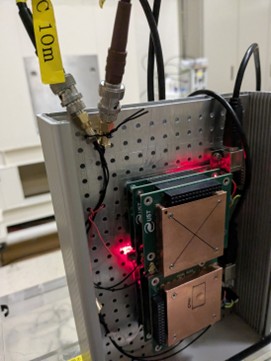
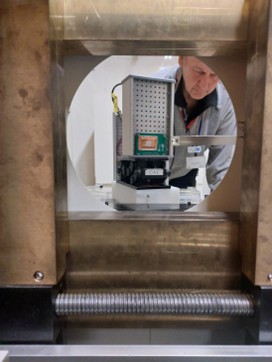
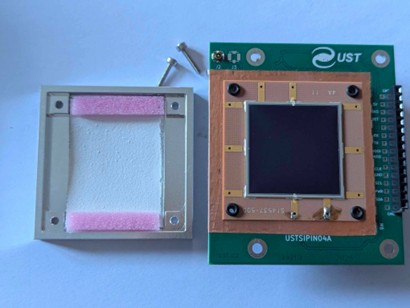
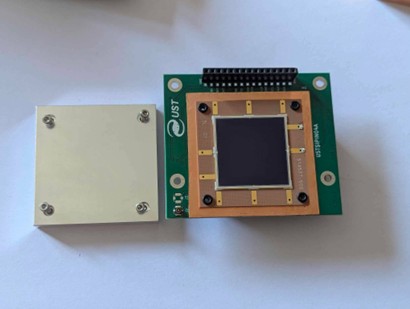
During the night of 11–12 March 2026, an experiment using a 160 MeV proton beam was conducted at the Japanese HIMAC accelerator. The main objective was to test a new large-area semiconductor diode with dimensions of 28 × 28 mm², which will serve as a sensor for the CZPAD personal dosimeter.
The experiment focused on the arrangement of two diodes in a telescopic configuration and on verifying the coincidence function, which is intended to enable reliable discrimination between charged particles and neutrons. The measurements also included testing of conversion layers that transform thermal neutrons into secondary charged particles detectable by the semiconductor detector.
Read also
- SPACEDOS detectors meet the limits for operation aboard a spacecraft
- Ivo Světlík awarded the First-class Medal of the Ministry of Education, Youth and Sports
- NPI CAS and Korea’s KINS Strengthen Cooperation in Cosmic Radiation and Aviation Radiation Protection
- NPI CAS organised the 29th international WRMISS workshop
- NPI CAS was the main organizer of the 26th European Conference on Few-Body Problems in Physics
- The Mayor of Brno visited the Laboratory of Microtron
- Describing unusual winter lightning could help extend the lifespan of wind turbines
- The solar eclipse and its impact on cosmic radiation
- 3D scanning helps select eggs for a future ISS mission
- Unique CRL method opens new possibilities for dating prehistoric rock art
