
3D scanning helps select eggs for a future ISS mission
07. 08. 2026

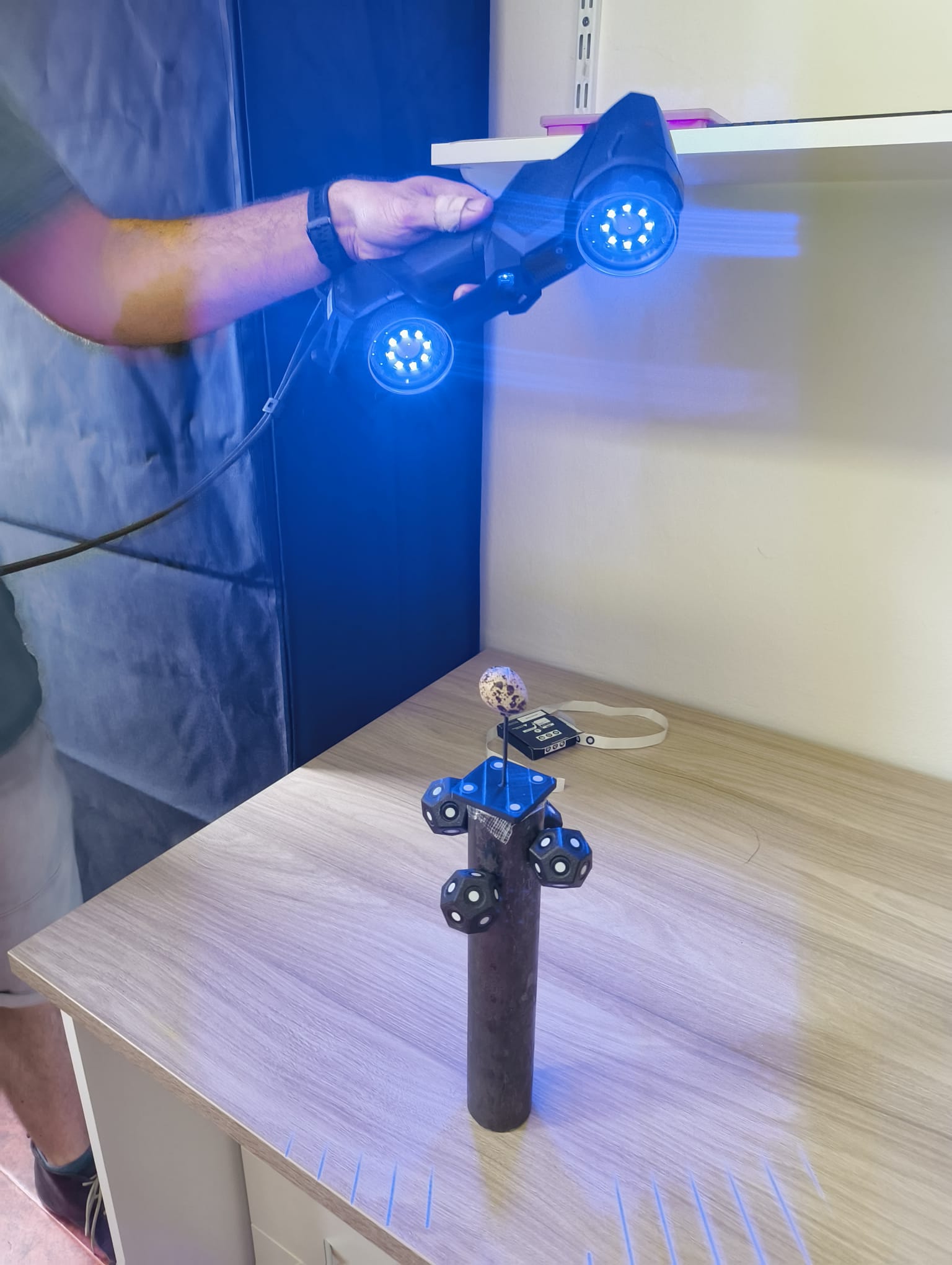
Preparations for the ZOE project, one of two projects from the Nuclear Physics Institute of the Czech Academy of Sciences (NPI CAS) selected by the European Space Agency (ESA) for the scientific programme of the Czech astronaut's mission to the International Space Station (ISS), have reached another important milestone. In collaboration with the Research Centre Řež, researchers have carried out high-precision 3D scanning of Japanese quail eggs.
Using digital 3D models, the team is determining the dimensions, volume, and shape of individual eggs. These data will be used to design and optimise the internal protective components of the transport containers and to establish selection criteria for identifying the eggs best suited for the experiment.
The goal is to provide the highest possible level of protection for the biological samples during both the rocket launch and their journey to the International Space Station, when they are exposed to vibrations, acceleration, and other mechanical stresses.
As part of the research, the team will also investigate whether certain morphological characteristics of the eggs, such as their size or shape, influence their mechanical resistance during transport. The findings will contribute to the development of safer transport systems for biological experiments conducted in space.
Project ZOE investigates how microgravity and cosmic radiation affect the early embryonic development of vertebrates. Its aim is to improve our understanding of the biological limits of long-duration human space missions and the prospects for future human life beyond Earth. Learn more about the project here.



Read also
- NPI hosted a workshop on the potential impact of Earth's geomagnetic field on climate
- NPI scientists test dosimeters for Czech astronaut at LR-0 reactor
- NPI opens new facility with a high-activity cobalt irradiator
- SPACEDOS detectors meet the limits for operation aboard a spacecraft
- Ivo Světlík awarded the First-class Medal of the Ministry of Education, Youth and Sports
- NPI CAS and Korea’s KINS Strengthen Cooperation in Cosmic Radiation and Aviation Radiation Protection
- NPI CAS organised the 29th international WRMISS workshop
- NPI CAS was the main organizer of the 26th European Conference on Few-Body Problems in Physics
- The Mayor of Brno visited the Laboratory of Microtron
- Describing unusual winter lightning could help extend the lifespan of wind turbines
