
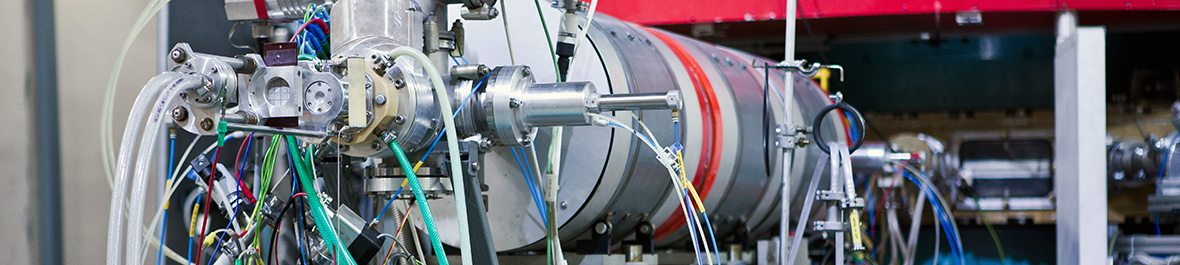
NPI scientists tested a new neutron detector for materials research at ESS
16. 07. 2026

Scientists from the Laboratory of Neutron Physics at the Nuclear Physics Institute of the Czech Academy of Sciences (NPI CAS) participated in testing a neutron detector for the BEER instrument, which is being developed for the European Spallation Source (ESS) – one of Europe's most important research infrastructures for neutron science. The measurements were carried out at the horizontal beam channels of the LVR-15 research reactor in Řež.
The BEER (Beamline for European Engineering Research) instrument will be used at ESS to investigate the properties of engineering materials using neutron diffraction once the facility becomes operational. It will enable researchers to investigate, for example, residual stresses, deformation mechanisms, and the microstructure of materials. This is essential for the development of new structural materials and the assessment of their reliability.
During the week-long testing campaign, the researchers verified the detector's key performance characteristics. They focused primarily on its homogeneity, neutron detection efficiency, spatial resolution, and the so-called count-rate performance, i.e. its ability to reliably detect neutrons even at high event rates.
The testing also made it possible to verify the detector's operating parameters and configure its firmware prior to its future deployment on the BEER instrument. Another important milestone was the successful recording of the first diffraction patterns from an engineering sample in the form of Debye–Scherrer rings, confirming the detector's correct performance under real experimental conditions.
The detector under test uses a thin layer of boron carbide enriched in boron-10 (¹⁰B₄C) as the neutron conversion material. When a thermal neutron is captured, charged particles are produced, generating an electrical signal in the detector's gas volume. Using delay-line technology, the position of the neutron interaction can then be determined with high precision.
The testing involved experts from the Nuclear Physics Institute of the Czech Academy of Sciences, the European Spallation Source (ESS), and the detector developers from the Helmholtz-Zentrum Hereon research centre in Germany. Among the participants was Gergely Németh, a former member of the Laboratory of Neutron Physics at NPI CAS, who is now affiliated with ESS. The measurements were further supported by the operators of the LVR-15 research reactor, colleagues from the Department of Neutron and Ion Methods led by Dr Gergely Farkas and Vasyl Ryukhtin, as well as Dr Matoušková from the Czech Technical University in Prague (CTU).


Read also
- NPI hosted a workshop on the potential impact of Earth's geomagnetic field on climate
- NPI scientists test dosimeters for Czech astronaut at LR-0 reactor
- NPI opens new facility with a high-activity cobalt irradiator
- SPACEDOS detectors meet the limits for operation aboard a spacecraft
- Ivo Světlík awarded the First-class Medal of the Ministry of Education, Youth and Sports
- NPI CAS and Korea’s KINS Strengthen Cooperation in Cosmic Radiation and Aviation Radiation Protection
- NPI CAS organised the 29th international WRMISS workshop
- NPI CAS was the main organizer of the 26th European Conference on Few-Body Problems in Physics
- The Mayor of Brno visited the Laboratory of Microtron
- Describing unusual winter lightning could help extend the lifespan of wind turbines
