
NPI explores the potential of ultra‑sensitive quantum sensors
02. 03. 2026
Research at the Nuclear Physics Institute of the Czech Academy of Sciences (ÚJF AV ČR) demonstrates how accelerated charged particles—ion beams produced by the Tandetron accelerator—can be used to modify the properties of materials with atomic‑level precision. By deliberately creating defects in crystal lattices at the nano‑ and micrometre scale through ion irradiation and ion‑beam lithography, researchers can tailor the structural and electronic characteristics of solids. These techniques are essential for the development of next‑generation sensor materials, miniaturized multifunctional sensing devices, and, in the long term, extremely sensitive quantum sensors. The research holds significant potential for applications in medicine, industry, and emerging high‑tech fields.
Research at the Nuclear Physics Institute of the Czech Academy of Sciences (ÚJF AV ČR) demonstrates how accelerated charged particles—ion beams produced by the Tandetron accelerator—can be used to modify the properties of materials with atomic‑level precision. By deliberately creating defects in crystal lattices at the nano‑ and micrometre scale through ion irradiation and ion‑beam lithography, researchers can tailor the structural and electronic characteristics of solids. These techniques are essential for the development of next‑generation sensor materials, miniaturized multifunctional sensing devices, and, in the long term, extremely sensitive quantum sensors. The research holds significant potential for applications in medicine, industry, and emerging high‑tech fields.
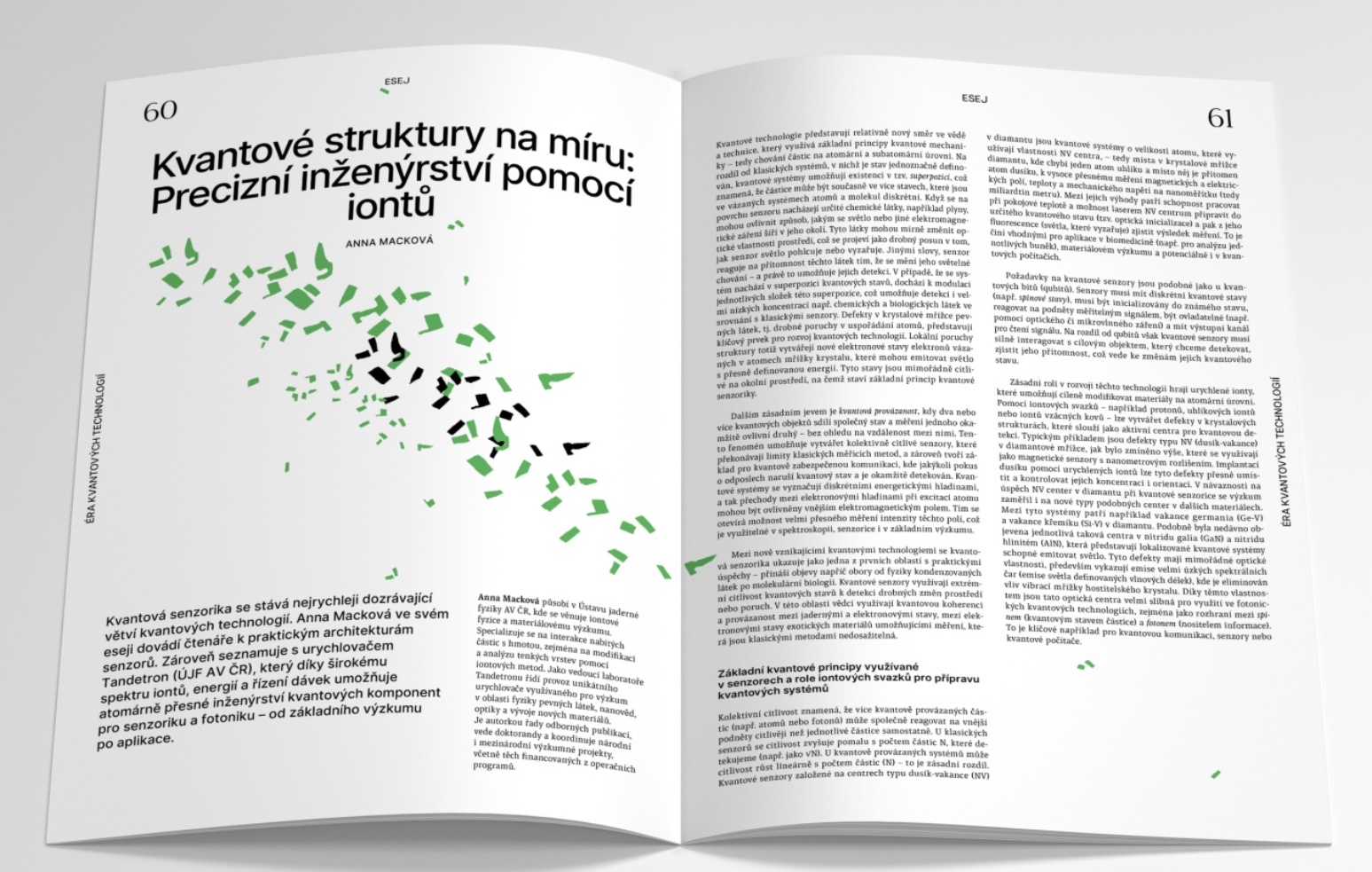
Prof. Anna Macková has published an article on quantum sensors in Academix Revue. In her contribution, she explains how high‑energy ion‑beam technologies enable the controlled modification of materials in ways that make it possible to detect extremely weak physical phenomena. Quantum‑technology research from the perspective of ion physics and materials science has been a long‑standing focus at ÚJF.
The special issue of Academix Revue devoted to quantum phenomena was supported by the AMULET project, in which ÚJF participates as a partner.
Ion‑Beam Methods in ÚJF Experimental Research
In her essay, Prof. Macková introduces the fundamental principles of quantum sensing, which relies on the extraordinary sensitivity of quantum states to external stimuli. She focuses on defects in crystalline solids that create localized electronic states responsive to electromagnetic fields, temperature changes, or chemical composition. Such structures enable the detection of extremely low concentrations of substances that are difficult or impossible to measure using classical analytical methods. Ion beams make it possible to create these defects in a controlled manner and to precisely tune their spatial distribution and concentration.
The essay highlights one of the most fascinating areas of modern solid‑state physics: engineered point defects in crystal lattices that function as controllable quantum systems. These include, for example, nitrogen–vacancy (NV) centres in diamond. Prof. Macková also discusses quantum dots and nanostructures, whose optical and electronic properties can be precisely tuned by adjusting the energy and dose of implanted ions. Such engineered defects and nanostructures are now among the key building blocks for the development of quantum technologies, advanced sensing platforms, and the next generation of semiconductor devices.
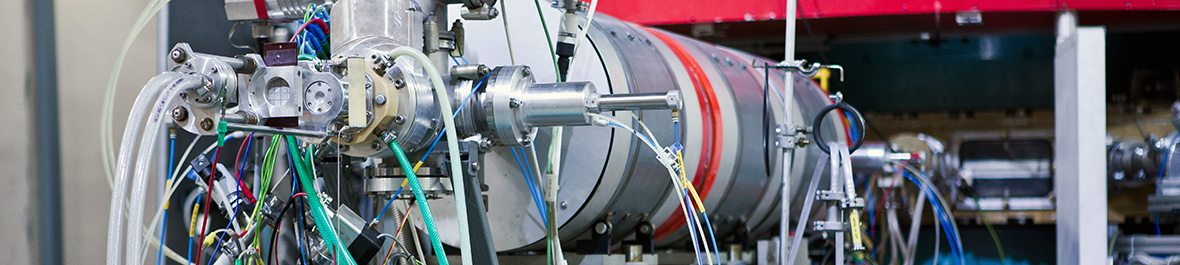
A central role in this research is played by the Tandetron accelerator, the only facility of its kind in the Czech Republic. It provides ion beams across a wide range of energies and masses. By precisely controlling experimental parameters, researchers can tailor the implantation depth and degree of structural modification—from subtle tuning of quantum properties to more extensive material transformations.
The essay is here.
Read also
- Testing of a new large-area diode at the HIMAC accelerator
- Special seminars at the NPI mark the 80th birthday of Prof Jan Kučera, Prof Pavel Exner and Dr Miloslav Znojil
- The NPI cooperates with the Czech Armed Forces
- Two special seminars will take place in March at the NPI to celebrate the 80th birthdays of our colleagues
- Vladimír Wagner spoke on Český rozhlas about the risks of Iran’s nuclear program
- The NPI reaches key milestone in AlphaStar project
- President of the Czech Academy of Sciences Radomír Pánek visits the Nuclear Physics Institute
- The Nuclear Physics Institute helps improve lithium-ion batteries
- Change of the Registered Office Address of the Nuclear Physics Institute of the CAS
- 70 years of the Nuclear Physics Institute in the journal Jaderná energie
