
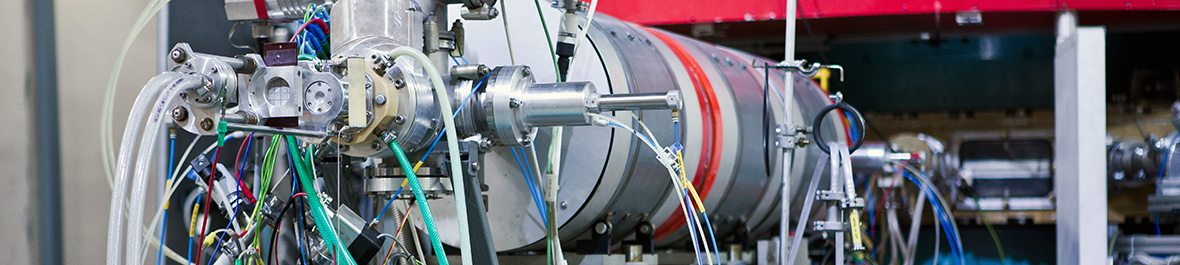
CZPAD project
The CZPAD (Czech Personal Active Dosimeter) project is a dosimetric experiment of the Nuclear Physics Institute of the Czech Academy of Sciences, carried out in cooperation with the European Space Agency (ESA) as part of the scientific programme of the Czech astronaut’s mission to the International Space Station (ISS). The experiment provides a unique opportunity to validate a personal active dosimeter under real spaceflight conditions.
The aim of the project is to test the performance of a new dosimetric system based on the SPACEDOS detector and to verify its ability to measure cosmic radiation doses in real time, including the neutron component, which constitutes a significant part of astronauts’ radiation exposure. Neutron measurement represents one of the key and technically most demanding aspects of the experiment; notably, the astronaut’s own body also plays a role in the measurement process.
To date, astronauts’ radiation exposure has been assessed primarily using passive dosimeters evaluated only after return to Earth. This approach, however, is not suitable for long-duration deep-space missions, such as missions to the Moon or Mars. The CZPAD project therefore contributes to the development of active personal dosimetry, enabling continuous risk assessment and timely implementation of protective measures.
During the mission, the astronaut will wear three active SPACEDOS dosimeters placed on different parts of the body (for example, the chest, lower back, and thigh), with their positions changing between individual days. A fourth dosimeter will serve as a reference unit. Each device contains two independent measurement modules, one of which is equipped with a special conversion layer enabling the detection of thermal neutrons based on a patented method developed by a Czech research team. The measured values will be displayed using a Dosimeter Display Unit (DDU) in the form of a wristwatch, which will be used in space for the first time.
The results of the experiment will contribute to enhancing astronaut safety during future long-duration crewed missions. In addition, the new insights into neutron interactions with the human body have the potential for application in terrestrial fields such as aviation, nuclear energy, and healthcare.
Research Team
The CZPAD experiment is conducted at the Nuclear Physics Institute of the Czech Academy of Sciences in cooperation with Universal Scientific Technologies s.r.o. (UST), which participates in the technical development of the dosimetric system as a subcontractor. The experiment is carried out by a team of experienced experts specialising in dosimetry, space radiation, and the development of detection systems.
Iva Ambrožová is the principal investigator of the project and works at the Department of Radiation Dosimetry of the Nuclear Physics Institute of the Czech Academy of Sciences. She has long been engaged in dosimetric and microdosimetric methods of ionising radiation, including applications in aviation, space research, and medicine. She has more than twenty years of professional experience in personal and environmental dosimetry and has participated in numerous international projects focused on radiation protection.
Contact: ambrozova@ujf.cas.cz
Martin Kákona focuses at the Nuclear Physics Institute of the Czech Academy of Sciences on the development of electronics for space radiation measurements and open dosimetric systems, including AIRDOS and SPACEDOS. He is involved in both hardware design and the analysis of data from space missions. He is currently undertaking a research stay at NASA and Lawrence Berkeley National Laboratory, where he works on the processing of data from the International Space Station. He is the author of three patents, more than twenty scientific publications, and a co-developer of the modular electronics platform MLAB. In addition to research activities, he is also involved in teaching and the development of innovative detection technologies.
Contact: kakona@ujf.cas.cz
Partners collaborating on the CZPAD project:
- The elastic band was supplied by ELAS (https://elas.cz/).
- The flame-resistant TenCate fabric was supplied by Encetex (www.encetex.cz).
- The procurement of flame-resistant threads and embroidery is provided by pete - c (https://pete-c.com/).
- Testing and calibration of the SPACEDOS detector on the LR-0 reactor are carried out by ÚJV Řež a.s.
- Neutron converters containing Li-6 and a polymer binder are prepared by the Institute of Macromolecular Chemistry of the Czech Academy of Sciences.

Content prepared based on information available on the Česká cesta do vesmíru website (ceskacestadovesmiru.cz).
