
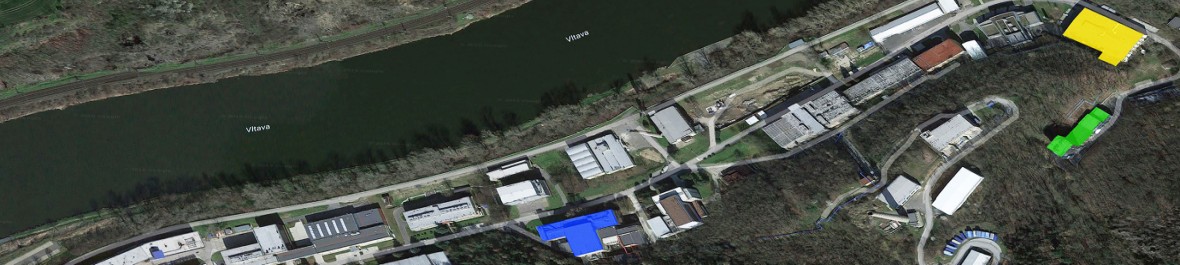
Laboratory of AMS (LAMS)
Laboratory of Accelerator Mass Spectrometry (AMS) is operated as a Shared workspace of Nuclear Physics Institute of the Czech Academy of Sciences (NPI), Faculty of Nuclear Sciences and Physical Engineering of the Czech Technical University in Prague (CTU), and Institute of Archaeology of the Czech Academy of Sciences, Prague (ARÚ). The laboratory was established within the ESIF OP project "RAMSES - Ultra-trace isotope research in social and environmental studies using accelerator mass spectrometer" and opened in 2022.
The laboratory is equipped with a MILEA system (Multi Isotope Low Energy AMS, Ionplus AG, Switzerland) capable of measurement of long-lived radionuclides 10Be, 14C, 26Al, 41Ca, 129I, 236U and several other actinoids. Besides the mass spectrometer, the laboratory operates chemical laboratories for sample processing and other dedicated instruments.
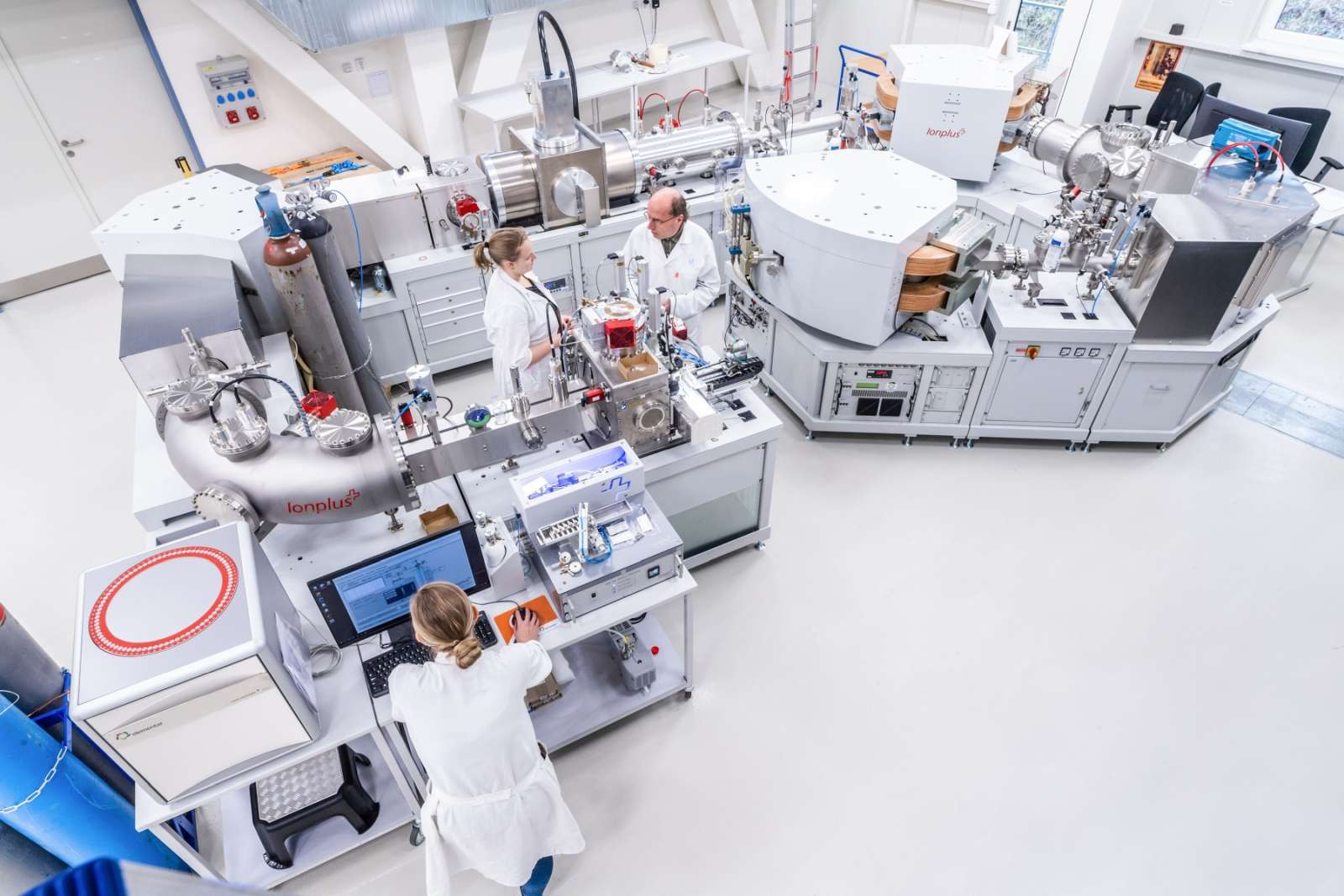
MILEA system for accelerator mass spectrometry with 300-kV tandem accelerator.
(Foto: CAS - Jana Plavec)
Worldwide, AMS is the most frequently used for measurement of 14C (radiocarbon). The sensitivity is orders of magnitude better in comparison to radiometric methods (e.g., liquid scintillation counting). Radiocarbon is produced by cosmic rays naturally. It is also produced by neutron induced nuclear reactions in nuclear reactors and during nuclear weapon tests.
The applications of 14C include radiocarbon dating, forensic applications and control of the trade with critically endangered animals and plants, sensitive monitoring of the environment around nuclear installations, distinguishing of the fossil and recent carbon (fossil fuels and bio-fuels). The laboratory reserves 60 % of the AMS beam-time for 14C measurement. The domain is being largely developed and utilized by the Radiocarbon laboratory CRL at the Department of Radiation Dosimetry of the NPI, frequently in co-operation with ARÚ. Details are described in a separate presentation.
Cosmogenic nuclides 10Be and 26Al are produced in quartz at the surface layer of our planet by secondary cosmic radiation in minute quantities. They serve as a useful tool for dating of geological and geomorphological features by exposure dating. In addition, materials from the Earth surface buried by layers of rock and sediments can be used for burial dating. Quantities of 10Be produced by cosmic radiation in the atmosphere (meteoric 10Be) and later deposited on the Earth surface at the top layers of soil and sediments could indicate for example erosion rate, solar activity fluctuation, precipitation histories. The nuclides 10Be and 26Al are formed in larger quantities in the space and might unveil interesting details about history and origin of the meteorites and other extraterrestrial objects. The AMS beam-time reserved for 10Be and 26Al is 15%. The domain of these cosmogenic nuclides is being developed and utilized by the Radioanalytical methods team at the Department of Neutron and Ion Methods of the NPI in cooperation with interested partners from the national institutions and those from abroad.
Measurement and application of 129I (fission product), 236U with other actinoids, and 41Ca is a domain of colleagues from CTU. The radionuclides are present in the environment naturally at extremely low level. They are artificially produced by operation of nuclear installations (nuclear reactors, spent fuel reprocessing plants) and during nuclear explosions. Sensitive measurements are important for monitoring of these activities. Radioactive 129I and 236U are useful tracers for oceanography. Rare actinoids are frequently used for nuclear forensic purposes. Quantification of 41Ca in concrete is often required for characterization of the waste from decommissioning of nuclear power plants. The AMS beam-time reserved in the laboratory for measurement of these nuclides is 25%.
Contacts
| Coordinator LAMS | Kateřina Pachnerová Brabcová |
| Deputy coordinator | Ivo Světlík |
| svetlik@ujf.cas.cz | |
| +420 266 177 233 | |
| Instrument responsible LAMS | |
| 14C measurement | Ivo Světlík (contacts above) |
| Cosmogenic radionuclides | Jan Kameník |
| kamenik@ujf.cas.cz | |
| +420 212 241 683 | |
